
The mortal remains were brought to the Madras Regimental Centre where people paid floral tribute to General Rawat and other personnel.

Amazon Prime Video has announced a huge number of assorted Web series and movies, and the slate sure looks interesting.

The British police have arrested two more people, including a woman, in connection with the assassination attempt in London on Lieutenant General (retired) K S Brar, who had led Operation Blue Star against Khalistani terrorists in 1984. Brar, 78, who was in London on a private visit, was returning to his hotel with his wife when he was attacked in central London by four men on September 30. He suffered injuries on his neck and cheek.
The meeting, to be chaired by Union Home Secretary RK Singh, and to be attended by Army, Maharashtra police and others, will also review whether there was any security lapse anywhere leading to the assassination attempt on 78-year-old Brar on Sunday
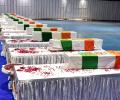
The armed forces personnel whose bodies were identified in the last few hours are Junior Warrant Officer (JWO) Pradeep, Wing Commander P S Chauhan, JWO Rana Pratap Das, Lance Naik B Sai Teja and Lance Naik Vivek Kumar.

Based mainly on his reconnaissance reports, the Indian Army went ahead with the mission to occupy the Siachen heights under the Operation Meghdoot.

The government has decided to provide security to Brigadier (retd) Israr Rahim Khan, who led the first army troops that entered the Golden Temple in Amritsar during Operation Blue Star.
In a swift action, the army said on Tuesday it had taken 'strict disciplinary action against soldiers who had misbehaved with tourists in the south Kashmir's health resort of Pahalgam on Monday.'
The Army on Monday rubbished allegations levelled by hardline Hurriyat Conference led by Syed Ali Shah Geelani that the force was trying to hush up the alleged rape of a woman by two men in uniform in south Kashmir last week.
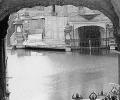
B D Pande was Punjab's governor during Operation Bluestar. In this excerpt from his memoir, In the Service of Free India: Memoir of a Civil Servant, Pande reveals what really went on behind the scenes during those dark days in India's history.
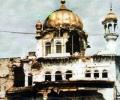
British military's role in the 1984 Operation Blue Star to flush out militants from the Golden Temple was "limited" and "purely advisory", Foreign Secretary William Hague told the British parliament on Tuesday.

The end for the doughty soldier came a little before noon, three days after he was miraculously pulled out alive from under 30 feet of ice-and-snow debris where he lay buried for six days on the unforgiving Siachen glacier.
